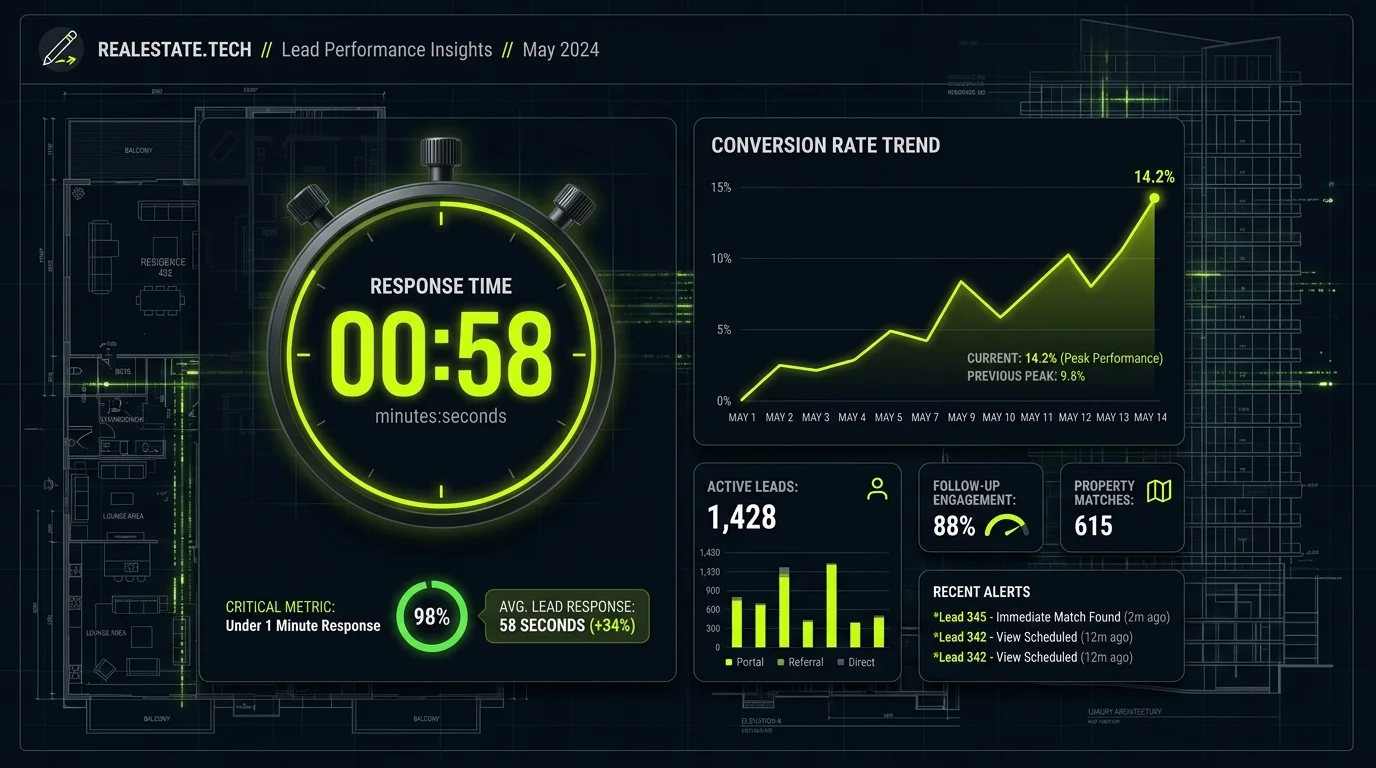
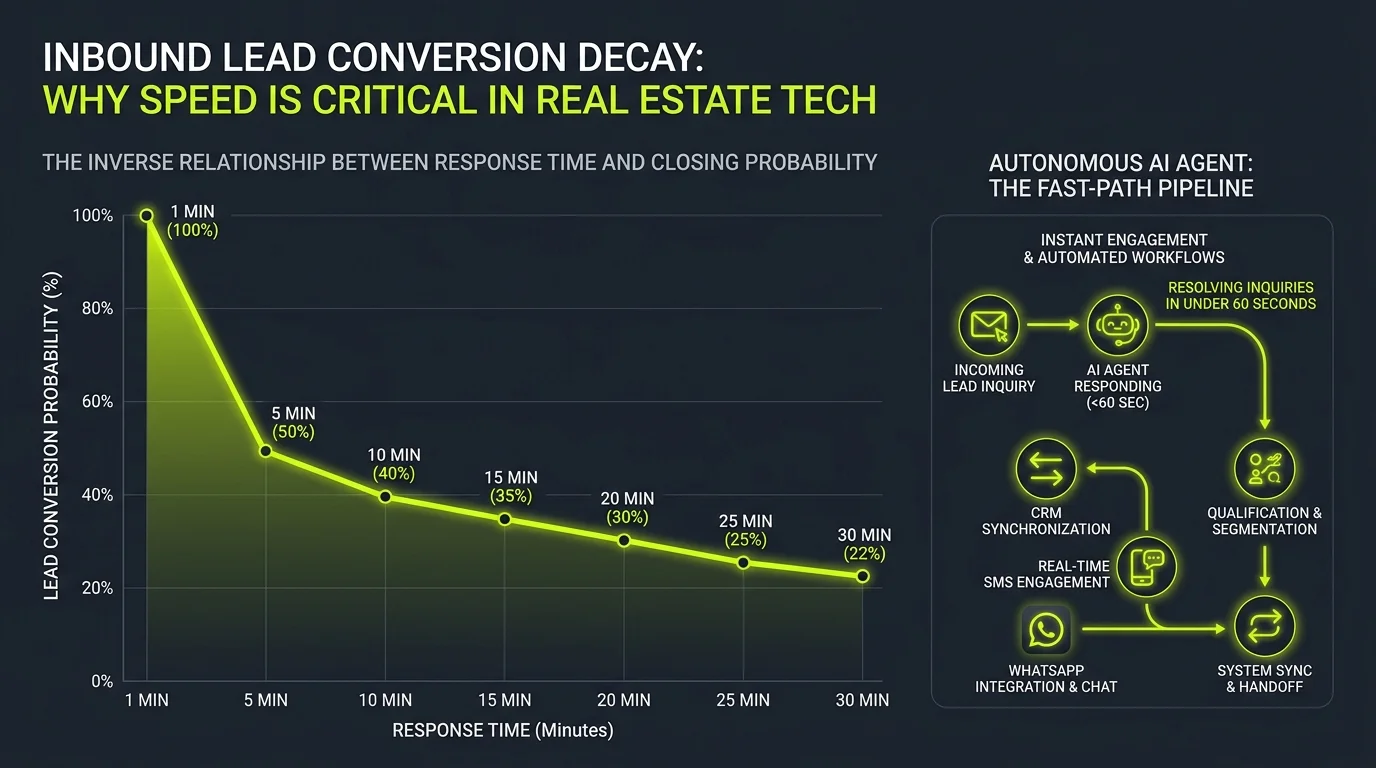
The brutal mathematics of inbound lead decay
In high-ticket sales, luxury real estate, and B2B services, inbound leads do not decay gradually—they evaporate off a cliff. When an affluent buyer or corporate decision-maker fills out a contact form on your website or portal, their psychological intent, browser attention, and urgency are at their absolute apex.
The landmark Lead Response Management Study conducted by Dr. James Oldroyd (MIT) and InsideSales analyzed over 15,000 unique leads and 100,000 call attempts across three years. The empirical findings remain staggering:
If you reach a prospect within 60 seconds, you are catching them while their screen is still lit, their phone is in their palm, and the mental model of their problem is completely active. At 15 minutes, they have opened Instagram, joined a Zoom meeting, or walked into a client presentation. At 2 hours, your caller ID is just an unknown number to decline.
Why second place is zero in competitive markets
When someone is searching for a luxury home in Austin, a penthouse in Dubai, or enterprise workflow automation, they rarely submit a single form. They open four browser tabs. They click two Instagram lead generation ads. They fill out three portal inquiries on Zillow or Realtor.com.
The company that responds first does not merely get a polite greeting—they anchor the criteria for the entire transaction:
- Frictionless Momentum: The first competent responder answers the initial pressing questions, establishes rapport, and schedules the private viewing or technical demo.
- Fatigue Sets In: By the time the second broker or SDR calls 45 minutes later, the buyer feels their immediate need was already addressed: "Thanks, I'm already chatting with someone about that property."
- The Winner Takes 78%: According to Velocify research, 78% of customers buy from the vendor that responds first. Coming in second with a "more polished pitch" an hour later yields an ROI of zero.
The structural failure mode of human SDR teams
Most brokerage owners and sales leaders understand the value of speed. Yet, across thousands of real estate teams and B2B organizations, the average inbound lead response time hovers at 47 minutes during business hours—and stretches to over 14 hours during evenings and weekends.
This is not due to laziness; it is a structural limitation of biology and human workflow:
- The Showing & Meeting Blackout: Your top agents are physically on site with buyers, negotiating contracts, or driving between appointments. They cannot safely or professionally pick up the phone when a cold inquiry arrives.
- Notification Fatigue & Context Delay: When a Zillow or web hook fires into an email inbox, the human rep must read the note, log into the CRM, look up the MLS listing, determine the pricing tier, and craft a message. That manual loop consumes 8 to 15 minutes minimum.
- The 65% After-Hours Void: Over 65% of high-intent real estate web searches and ad submissions occur between 6:00 PM and 11:00 PM on weekdays, or throughout Saturday and Sunday. Unless you pay a night-shift SDR rotation, those leads sit untouched until 9:30 AM the next morning—at which point conversion probability has fallen by 90%.
Model your inbound lead pipeline against empirical conversion decay curves. See exactly how much revenue your current response lag bleeds each year—and what sub-60-second AI recovers.
The anatomy of a sub-60-second autonomous AI pipeline
Achieving a 60-second response time does not mean spamming every lead with a brainless automated autoresponder that says "Thank you for your message, someone will contact you shortly." Prospects recognize generic templates instantly and ignore them.
A true sub-minute pipeline relies on autonomous agentic orchestration that executes four continuous actions in under 60 seconds:
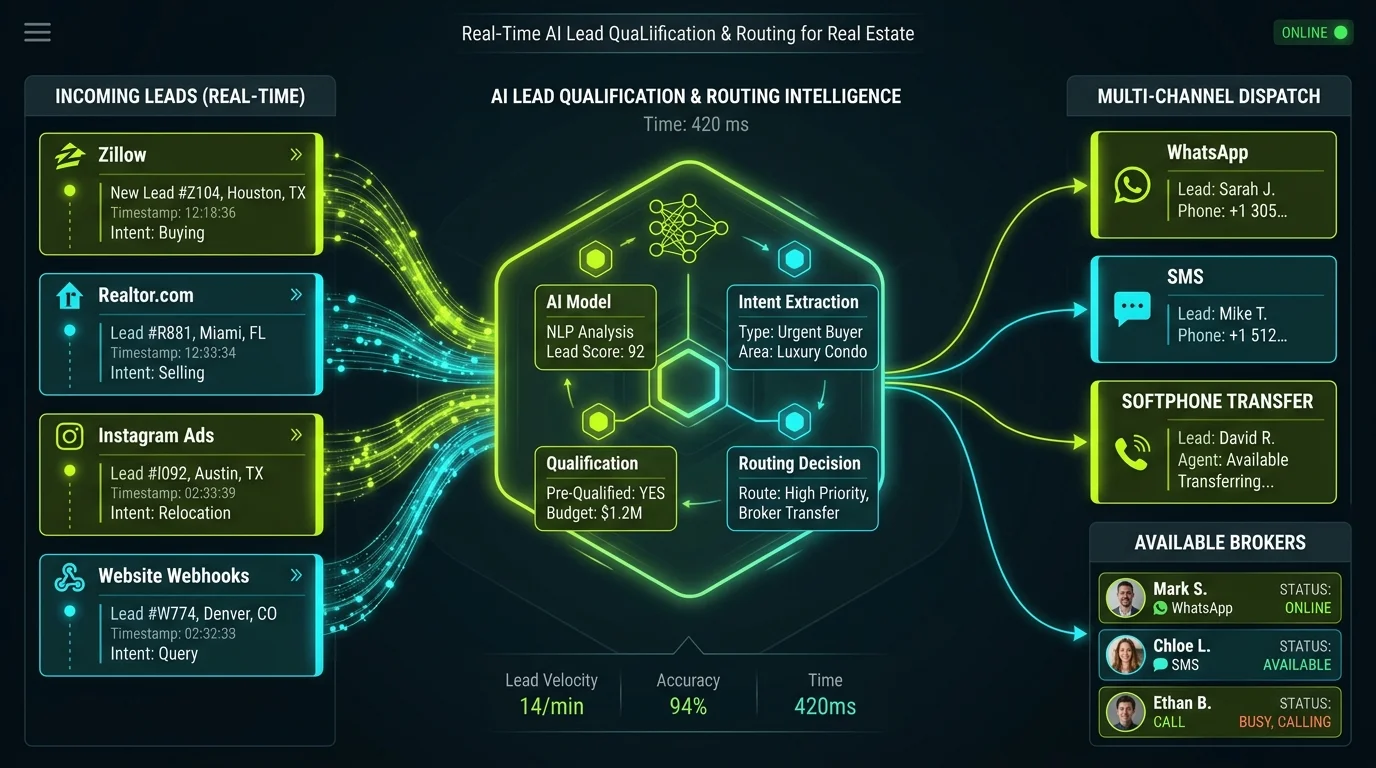
Omni-Source Ingestion & Payload Normalization
Inbound leads from Zillow Premier Agent, Realtor.com, Facebook Lead Ads, Google Local Services, and your website webhook are captured instantly. The payload is parsed, cleansed, and verified against phone validation APIs (carrier lookup to differentiate VoIP vs mobile SMS).
LLM Intent Extraction & Context Injection
A dedicated lightweight reasoning model inspects the prospect's query, listing address, price point, and timeline. The agent queries your MLS database or CRM in real time to pull context: Was this property price-reduced yesterday? Is it pending? Does it have an HOA?
Multi-Channel Conversational Engagement
Rather than an immediate cold robo-call, the AI selects the optimal channel (SMS in North America, WhatsApp in the UAE and Europe) and dispatches a personalized, natural opening note:
"Hey David — saw you were looking at 412 Ridgecrest. The seller just updated the inspection report this morning. Are you looking to tour this weekend, or just tracking comps in Barton Hills?"
Dynamic Qualification & Warm Broker Transfer
When the lead replies with their budget and timeframe, the AI updates the CRM, assigns a lead score, and initiates an immediate Slack or softphone whisper alert to the assigned broker: "Verified buyer David active right now on Ridgecrest ($1.2M budget, pre-approved). Tap to claim."
Human SDR vs. Autonomous AI Agent Benchmark
Comparing traditional sales workflows with modern autonomous agent architectures reveals why legacy teams are consistently out-converted:
| Metric | Traditional Human SDR / Agent | Autonomous AI Architecture |
|---|---|---|
| Average Response Latency | 47 mins (work hours) / 14+ hrs (nights) | 18 to 45 seconds (24/7/365) |
| Weekend & After-Hours Coverage | Sporadic / voicemails / zero coverage | Instant real-time multi-channel engagement |
| Context Injection | Manual CRM lookups (if done at all) | Real-time MLS data, tax records & listing history |
| Lead Contact Rate | 18% – 25% | 74% – 82% |
| Cost per Inbound Qualification | $35 – $75 per qualified conversation | < $1.50 in API compute costs |
| CRM Cleanliness & Logging | Inconsistent, missing notes, manual entry | 100% structured JSON logging & tags |
Speed without spam: 4 essential trust guardrails
Moving fast without discipline damages brand reputation and triggers carrier spam filters. When building autonomous speed-to-lead systems at DNK Labs, we mandate four strict guardrails:
- 1. The Non-Robotic Question Anchor: Never send a wall of text. The AI's first communication must always end with a single, low-cognitive-load question that is effortless for the recipient to answer with 3 words on mobile.
- 2. 10DLC Carrier Compliance: All SMS numbers must be registered with TCR (The Campaign Registry) under approved real estate campaign profiles with automated handling of STOP, UNSUBSCRIBE, and HELP directives.
- 3. Dynamic Timezone Fencing: Even if a lead fills out a form at 2:00 AM, never send an automated voice call or loud SMS chime outside 8:00 AM to 8:00 PM local recipient time. The AI stages the follow-up for 8:01 AM sharp.
- 4. Enterprise Security Guardrails: Every response passes through PromptDefend security layers to eliminate jailbreak attacks, prompt injections, or unauthorized pricing commitments.
How to deploy a 60-second pipeline in 14 days
You do not need to rewrite your entire technology stack to achieve sub-minute speed to lead. Follow our tested 3-step deployment blueprint:
Step 1: Webhook Centralization (Days 1–4). Unify your inbound lead sources (portals, paid social, landing pages) into a single high-availability webhook router with automatic deduplication.
Step 2: AI Context Agent Configuration (Days 5–9). Connect your listing database or MLS feed to our conversational engine. Calibrate tone, objection-handling prompts, and qualification thresholds.
Step 3: Human Warm Handoff & CRM Sync (Days 10–14). Wire instant notifications into your team's Slack or softphone system. When the AI qualifies an active prospect, the right broker receives immediate context with one-click dial.
Frequently asked questions
What is the 60-second speed-to-lead benchmark?
The 60-second speed-to-lead benchmark is the operational standard of acknowledging, analyzing, and engaging an inbound lead via SMS, WhatsApp, or voice callback within 60 seconds of form submission. Research indicates that leads responded to in under 1 minute have a 391% higher conversion rate than those contacted after 30 minutes.
Why do 78% of high-intent buyers choose the first responder?
When a prospect submits an inquiry, their intent, attention, and pain point are at absolute peak. The first vendor to initiate a meaningful conversation captures their mindshare, answers early questions, and anchors the evaluation process before competitors even open the notification.
Can human SDRs or real estate agents maintain a 60-second response time?
Human teams cannot maintain a 60-second response time consistently. Even high-performing sales teams average 47 minutes during business hours and over 14 hours during nights and weekends due to client showings, travel, meetings, and off-shift hours. Autonomous AI agents solve this by running 24/7/365 with sub-second execution.
Does rapid automated outreach sound robotic or spammy?
Not when built with deep dynamic context injection. Unlike static drip campaigns that send generic greetings, custom AI agents reference the specific property, listing price, referral source, and buyer notes in the initial message, delivering conversational authenticity at machine speed.